# Push vs Pull for CA Firms: What You Can Promote Online Under ICAI's 2026 Code
> Which CA services you can actively promote online and which stay pull-only under ICAI's Code of Ethics 2026, with channel-by-channel examples and clauses.
- Web page: https://cadevstack.com/guides/push-vs-pull-for-ca-firms/
- Author: CADevStack (https://cadevstack.com/)
- Published: 8 October 2026
- Primary source: https://resource.cdn.icai.org/92475coe2026v1.pdf
---
> **The short answer:**
> Under ICAI's Code of Ethics 2026, a CA firm's website and social media may use both "push" and "pull". Non-exclusive services such as accounting, tax advisory, GST and consultancy can be actively promoted. Services reserved for CAs by law, mainly audit and attestation, stay pull-only: shown to people who look for them, never sent out *(cl. 3.3.3–3.3.4, p. 153)*.
> **Key facts:**
> * **The rule:** clauses 3.3.3 and 3.3.4 of the Code of Ethics 2026, Volume I, page 153.
> * **In force from:** 1 April 2026 *(Code of Ethics 2026, p. 222)*.
> * **Not defined:** the Code uses "push" and "pull" without defining them. The explanations below are our reading of their ordinary meaning.
> * **Still banned:** solicitation. Push permission doesn't override Clause (6) of the CA Act's First Schedule *(p. 52)*.
---
## What does the Code actually say?
Two clauses decide it. Clause 3.3.3 allows both models and sets the limit:
> *"The websites of Chartered Accountants and/or Chartered Accountants' Firms or Network/Alliance of firms registered with ICAI may run on "Pull" as well as "Push" technology. For services which are exclusively reserved for Chartered Accountants, only "pull" model will be permitted to ensure that any person who wishes to locate the exclusive services of Chartered Accountants or Chartered Accountants' firms would only have access to the information and the information should be provided only on the basis of specific "pull" request."*
> — *Code of Ethics 2026, cl. 3.3.3, p. 153*
Clause 3.3.4 closes the obvious workaround, sending the website's audit information out some other way:
> *"none of the information pertaining to services which are exclusively reserved for Chartered Accountants contained in the Website be circulated on their own or through E-mail or by any other mode or technique except on a specific "pull" request."*
> — *Code of Ethics 2026, cl. 3.3.4, p. 153*
The same split reaches social media. The Code's definition of a "write-up" includes "social Networking Websites (in Push as well as in Pull mode)" *(cl. 3.1.2(iii), pp. 148–149)*. The website list of permitted details repeats the limit: "Exclusive services to be displayable only on specific "pull" request" *(cl. 3.3.7(vii), p. 154)*.
## What counts as push, and what counts as pull?
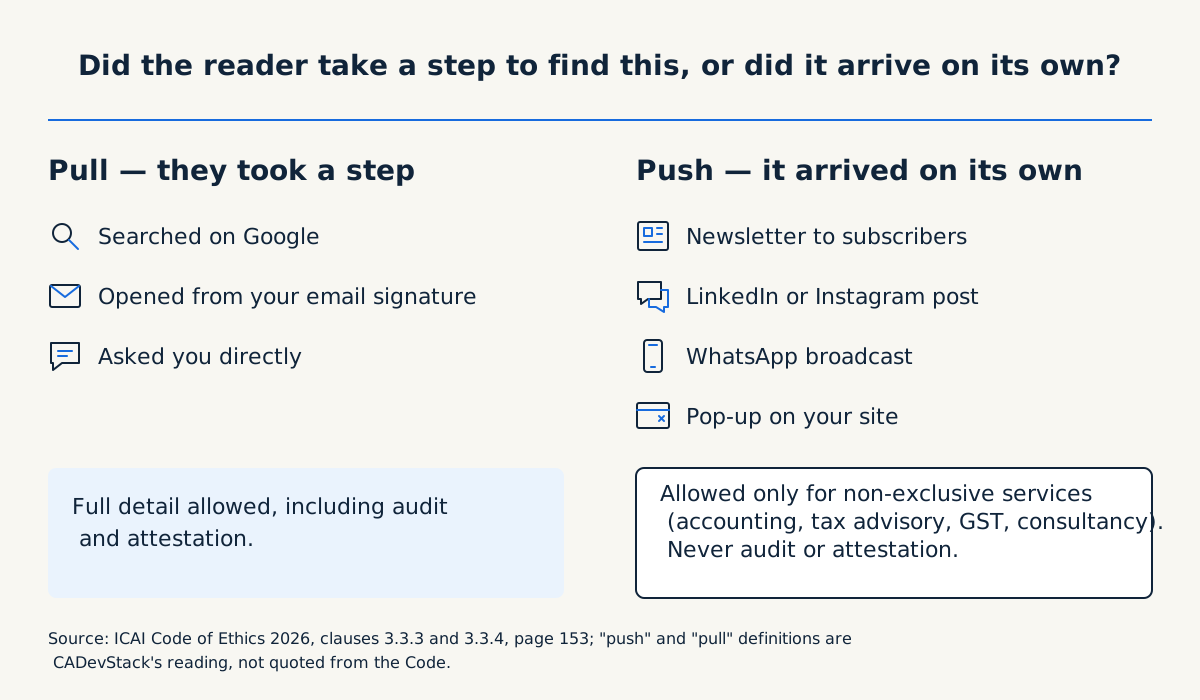
The Code doesn't define either word. **Our reading**, from their ordinary meaning and the wording of 3.3.3:
* **Pull:** someone comes looking. A prospect searches Google and lands on your audit page, opens your website from your email signature, or writes to ask whether you take on tax audits. The information reaches them because they asked for it.
* **Push:** your firm sends or places information in front of people who didn't ask for it. Newsletters, LinkedIn and Instagram posts, WhatsApp broadcasts, emails to a client list, and pop-ups that appear on their own are all push.
A useful test: **did the reader take a step to find this, or did it arrive on its own?** If it arrived on its own, treat it as push.
 ## Which services are "exclusively reserved"?
The Code doesn't publish a full list. It describes them as:
> *"services which are exclusively reserved for Chartered Accountants by statute viz. Audit and Attestation Services such as Audit under Companies Act 2013, Income Tax Act 1961, etc."*
> — *Code of Ethics 2026, cl. 2.14.1.6(iv)C(3), p. 55*
The tender guideline in Appendix K points the same way. It treats areas "open to other professionals along with the Chartered Accountants" as unrestricted *(Appendix K, p. 215)*.
So the test for each service is: **does a law say only a practising CA can do or sign it?** If advocates, Company Secretaries, Cost Accountants, tax or GST practitioners can also do it, it isn't exclusive.
> **Our reading:** The table applies that test to the laws named. It isn't legal advice. Confirm any borderline service for your own firm.
| Service | Exclusively reserved? | Online |
|---|---|---|
| Statutory company audit (Companies Act 2013, ss. 139 and 141) | Yes | **Pull only** |
| Tax audit (Income-tax Act 1961, s. 44AB) | Yes | **Pull only** |
| LLP statutory audit (LLP Act 2008, s. 34(4)) | Yes | **Pull only** |
| Certificates that a law requires a CA to sign | Yes | **Pull only** |
| Accounting and bookkeeping | No | Push and pull |
| Income tax returns and tax advisory | No | Push and pull |
| GST registration, returns and appeals | No (GST practitioners and advocates also do this) | Push and pull |
| Company formation and ROC filings | No (Company Secretaries and advocates also do this) | Push and pull |
| Management consultancy, including virtual CFO work | No: the Code lists it as Management Consultancy *(cl. 2.2.3, pp. 15–18)* | Push and pull |
> **Section numbers are changing.** The Income-tax Act, 2025 replaces the 1961 Act from tax year 2026-27. Audits for financial year 2025-26 still use section 44AB; from tax year 2026-27 the tax audit is under section 63 of the 2025 Act. Our reading: the classification doesn't change, only the section number.
## Examples: allowed or not?
Each row applies 3.3.3 and 3.3.4 to a channel firms actually use. The last column marks where we're reading the Code rather than quoting it.
| What the firm does | Push or pull? | Allowed? | Why |
|---|---|---|---|
| A website page describing your statutory audit practice, found through Google | Pull | Yes | The reader went looking *(cl. 3.3.3, p. 153)* |
| A LinkedIn post explaining a GST return change, mentioning that your firm handles GST compliance | Push | Yes | GST work is non-exclusive *(cl. 3.1.2(iii); 3.3.3)* |
| A monthly newsletter to subscribers on tax deadlines and your accounting services | Push | Yes | Non-exclusive services *(cl. 3.3.3, p. 153)* |
| The same newsletter adding "We are now accepting statutory audits for FY 2026-27" | Push | **No** | Audit information circulated without a request *(cl. 3.3.4, p. 153)* |
| An email to your client list announcing your tax audit team | Push | **No** | "Through E-mail or by any other mode" *(cl. 3.3.4)* |
| A prospect writes asking whether you take on company audits, and you reply with details | Pull | Yes | A specific pull request *(cl. 3.3.3)*. A firm profile may also go in reply to a specific query *(cl. 2.14.1.6(iv)I, p. 58)* |
| A homepage banner or pop-up saying "Book your statutory audit today" | Push | **No** | Our reading: content that appears without being asked for is push, and audit is pull-only *(cl. 3.3.3)* |
| A WhatsApp broadcast to people who aren't clients, offering ITR filing | Push | **Risky** | Our reading: ITR filing is non-exclusive, but messages to people likely to need a CA can be roving enquiries *(cl. 2.14.1.6(iv)K, p. 59)* |
## What push still doesn't allow
The 2026 change lets firms promote non-exclusive services. It doesn't lift the ban on solicitation, which applies to every service:
* **Soliciting clients** "either directly or indirectly by circular, advertisement, personal communication or interview or by any other means" is professional misconduct *(CA Act 1949, First Schedule, Part I, cl. (6); Code of Ethics 2026, p. 52)*.
* **Roving enquiries:** letters, emails or circulars addressed "specifically to persons who are likely to require services of a Chartered Accountant" aren't permitted *(cl. 2.14.1.6(iv)K, p. 59)*.
* **Asking people to visit your website** by circular or advertisement isn't permitted. Your website address on stationery and email is fine *(cl. 3.3.5, p. 153)*.
* **Asking people to visit or like your social pages** isn't permitted *(cl. 3.3.12, p. 156)*.
* **Every post is still a write-up**, so it must be honest, with no exaggerated claims, testimonials or slogans *(cl. 3.1.3A–G, p. 149)*.
> **Our reading:** Push means publishing useful, factual content where people can see it: your website, your page, your newsletter to people who subscribed. It doesn't mean contacting strangers who might need a CA. For paid ads, see [section 8 of our ICAI guide](https://cadevstack.com/guides/icai-advertising-guidelines-2026/#8-still-prohibited-outreach-and-solicitation).
## What this means for your firm's website
1. **Lead with non-exclusive services.** Your homepage, service pages and posts can describe GST, tax advisory, accounting and consultancy in full.
2. **Give audit its own factual page.** Describe what you do, with no "book now" buttons, banners or pop-ups. People reach it through search, the menu or an enquiry.
3. **Keep audit out of everything you send.** Newsletters, LinkedIn posts, WhatsApp updates and email footers shouldn't promote audit or attestation.
4. **Answer audit questions when asked.** A reply to a specific enquiry is pull, and you can give full details.
5. **Write insights about non-exclusive work.** Articles on GST or tax changes can be shared on LinkedIn and in newsletters, because the services behind them aren't reserved.
## Checklist
## Which services are "exclusively reserved"?
The Code doesn't publish a full list. It describes them as:
> *"services which are exclusively reserved for Chartered Accountants by statute viz. Audit and Attestation Services such as Audit under Companies Act 2013, Income Tax Act 1961, etc."*
> — *Code of Ethics 2026, cl. 2.14.1.6(iv)C(3), p. 55*
The tender guideline in Appendix K points the same way. It treats areas "open to other professionals along with the Chartered Accountants" as unrestricted *(Appendix K, p. 215)*.
So the test for each service is: **does a law say only a practising CA can do or sign it?** If advocates, Company Secretaries, Cost Accountants, tax or GST practitioners can also do it, it isn't exclusive.
> **Our reading:** The table applies that test to the laws named. It isn't legal advice. Confirm any borderline service for your own firm.
| Service | Exclusively reserved? | Online |
|---|---|---|
| Statutory company audit (Companies Act 2013, ss. 139 and 141) | Yes | **Pull only** |
| Tax audit (Income-tax Act 1961, s. 44AB) | Yes | **Pull only** |
| LLP statutory audit (LLP Act 2008, s. 34(4)) | Yes | **Pull only** |
| Certificates that a law requires a CA to sign | Yes | **Pull only** |
| Accounting and bookkeeping | No | Push and pull |
| Income tax returns and tax advisory | No | Push and pull |
| GST registration, returns and appeals | No (GST practitioners and advocates also do this) | Push and pull |
| Company formation and ROC filings | No (Company Secretaries and advocates also do this) | Push and pull |
| Management consultancy, including virtual CFO work | No: the Code lists it as Management Consultancy *(cl. 2.2.3, pp. 15–18)* | Push and pull |
> **Section numbers are changing.** The Income-tax Act, 2025 replaces the 1961 Act from tax year 2026-27. Audits for financial year 2025-26 still use section 44AB; from tax year 2026-27 the tax audit is under section 63 of the 2025 Act. Our reading: the classification doesn't change, only the section number.
## Examples: allowed or not?
Each row applies 3.3.3 and 3.3.4 to a channel firms actually use. The last column marks where we're reading the Code rather than quoting it.
| What the firm does | Push or pull? | Allowed? | Why |
|---|---|---|---|
| A website page describing your statutory audit practice, found through Google | Pull | Yes | The reader went looking *(cl. 3.3.3, p. 153)* |
| A LinkedIn post explaining a GST return change, mentioning that your firm handles GST compliance | Push | Yes | GST work is non-exclusive *(cl. 3.1.2(iii); 3.3.3)* |
| A monthly newsletter to subscribers on tax deadlines and your accounting services | Push | Yes | Non-exclusive services *(cl. 3.3.3, p. 153)* |
| The same newsletter adding "We are now accepting statutory audits for FY 2026-27" | Push | **No** | Audit information circulated without a request *(cl. 3.3.4, p. 153)* |
| An email to your client list announcing your tax audit team | Push | **No** | "Through E-mail or by any other mode" *(cl. 3.3.4)* |
| A prospect writes asking whether you take on company audits, and you reply with details | Pull | Yes | A specific pull request *(cl. 3.3.3)*. A firm profile may also go in reply to a specific query *(cl. 2.14.1.6(iv)I, p. 58)* |
| A homepage banner or pop-up saying "Book your statutory audit today" | Push | **No** | Our reading: content that appears without being asked for is push, and audit is pull-only *(cl. 3.3.3)* |
| A WhatsApp broadcast to people who aren't clients, offering ITR filing | Push | **Risky** | Our reading: ITR filing is non-exclusive, but messages to people likely to need a CA can be roving enquiries *(cl. 2.14.1.6(iv)K, p. 59)* |
## What push still doesn't allow
The 2026 change lets firms promote non-exclusive services. It doesn't lift the ban on solicitation, which applies to every service:
* **Soliciting clients** "either directly or indirectly by circular, advertisement, personal communication or interview or by any other means" is professional misconduct *(CA Act 1949, First Schedule, Part I, cl. (6); Code of Ethics 2026, p. 52)*.
* **Roving enquiries:** letters, emails or circulars addressed "specifically to persons who are likely to require services of a Chartered Accountant" aren't permitted *(cl. 2.14.1.6(iv)K, p. 59)*.
* **Asking people to visit your website** by circular or advertisement isn't permitted. Your website address on stationery and email is fine *(cl. 3.3.5, p. 153)*.
* **Asking people to visit or like your social pages** isn't permitted *(cl. 3.3.12, p. 156)*.
* **Every post is still a write-up**, so it must be honest, with no exaggerated claims, testimonials or slogans *(cl. 3.1.3A–G, p. 149)*.
> **Our reading:** Push means publishing useful, factual content where people can see it: your website, your page, your newsletter to people who subscribed. It doesn't mean contacting strangers who might need a CA. For paid ads, see [section 8 of our ICAI guide](https://cadevstack.com/guides/icai-advertising-guidelines-2026/#8-still-prohibited-outreach-and-solicitation).
## What this means for your firm's website
1. **Lead with non-exclusive services.** Your homepage, service pages and posts can describe GST, tax advisory, accounting and consultancy in full.
2. **Give audit its own factual page.** Describe what you do, with no "book now" buttons, banners or pop-ups. People reach it through search, the menu or an enquiry.
3. **Keep audit out of everything you send.** Newsletters, LinkedIn posts, WhatsApp updates and email footers shouldn't promote audit or attestation.
4. **Answer audit questions when asked.** A reply to a specific enquiry is pull, and you can give full details.
5. **Write insights about non-exclusive work.** Articles on GST or tax changes can be shared on LinkedIn and in newsletters, because the services behind them aren't reserved.
## Checklist
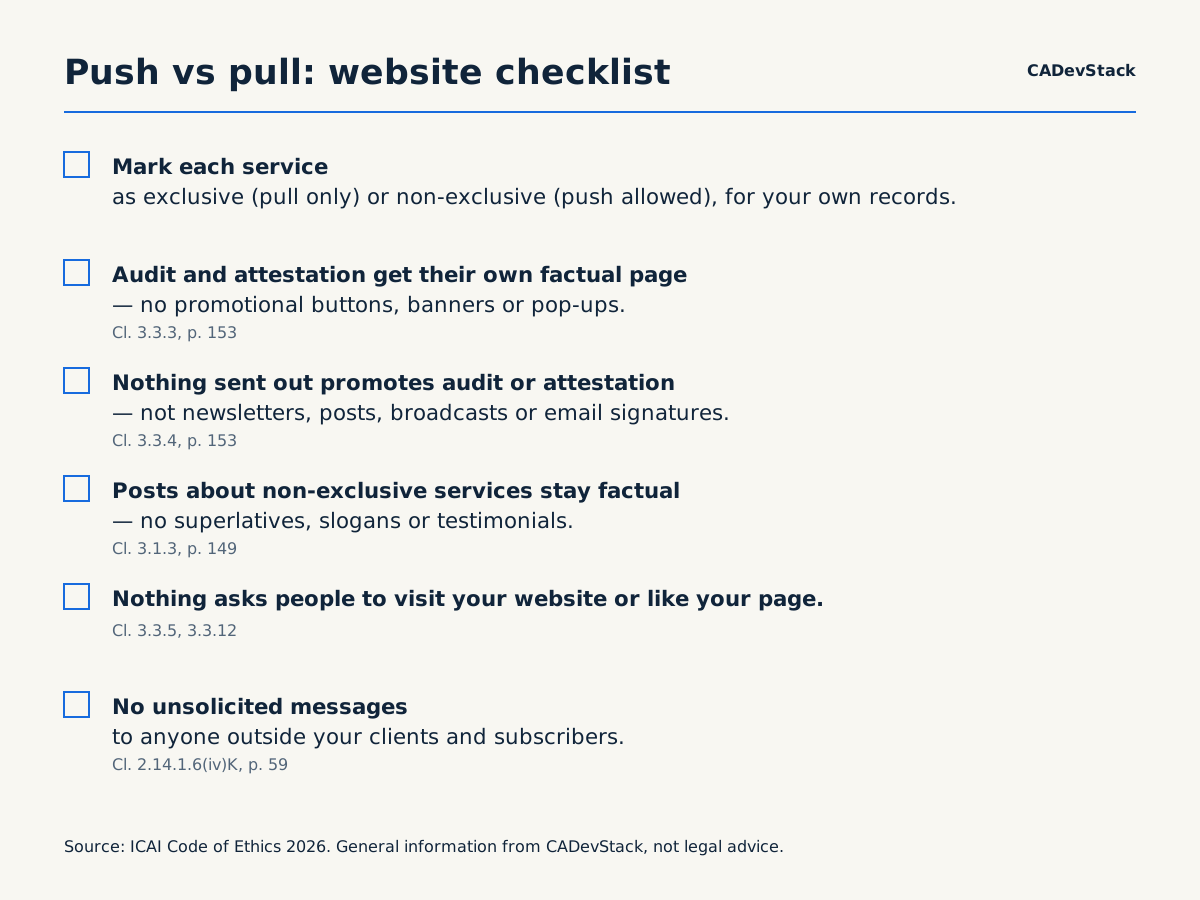 - [ ] Each service on your website is marked, for your own records, as exclusive (pull only) or non-exclusive (push allowed).
- [ ] Audit and attestation sit on a separate, factual page with no promotional buttons, banners or pop-ups *(cl. 3.3.3, p. 153)*.
- [ ] No newsletter, post, broadcast or email signature promotes audit or attestation *(cl. 3.3.4, p. 153)*.
- [ ] Posts about non-exclusive services are factual, with no superlatives, slogans or testimonials *(cl. 3.1.3, p. 149)*.
- [ ] Nothing asks people to visit your website or like your page *(cl. 3.3.5, 3.3.12)*.
- [ ] Nobody outside your clients and subscribers receives unsolicited messages about your services *(cl. 2.14.1.6(iv)K, p. 59)*.
Not sure which of your services fall on which side? [We'll check your website against these rules for free](https://cadevstack.com/#review) and tell you what to change first.
---
## Frequently asked questions
### Can a CA firm promote audit services on LinkedIn?
No. Audit and attestation are exclusively reserved for CAs by statute, so they're pull-only *(cl. 3.3.3, p. 153)*. A LinkedIn post appears in people's feeds without their asking, which makes it push. Describe your audit practice on your website instead, where people find it by looking.
### Can a CA firm send a newsletter?
Yes, for non-exclusive services such as tax, GST, accounting and consultancy *(cl. 3.3.3, p. 153)*. Keep audit and attestation out of it, since 3.3.4 bars circulating that information "through E-mail or by any other mode" without a specific request.
### Can a CA firm's website mention audit at all?
Yes. The website may describe exclusive services, as long as they're shown only to people who look for them *(cl. 3.3.3, p. 153; cl. 3.3.7(vii), p. 154)*. Our reading: a factual audit page reached through the menu or search is fine; a homepage banner promoting audit isn't.
### Is GST work exclusive to Chartered Accountants?
No. GST practitioners and advocates can also register taxpayers, file returns and appear in GST matters, so it's non-exclusive and can be promoted online *(cl. 3.3.3, p. 153; CGST Act, s. 48)*.
### Does "push allowed" mean a CA firm can message prospects?
No. Clause (6) of the CA Act still bans soliciting clients by "personal communication … or by any other means" *(p. 52)*, and roving enquiries to people likely to need a CA aren't permitted *(cl. 2.14.1.6(iv)K, p. 59)*. Push covers publishing, not cold outreach.
---
## Sources
1. **ICAI Code of Ethics, 2026 (13th Edition), Volume I.** Clauses 3.1.2(iii), 3.1.3, 3.3.3, 3.3.4, 3.3.5, 3.3.7(vii), 3.3.12; 2.14.1.6(iv)C(3), I and K; 2.2.3; Appendix K; effective date, p. 222. [Code of Ethics 2026, Volume I (PDF, icai.org)](https://resource.cdn.icai.org/92475coe2026v1.pdf)
2. **The Chartered Accountants Act, 1949,** First Schedule, Part I, Clause (6). [India Code (indiacode.nic.in)](https://www.indiacode.nic.in)
3. **ICAI Press Release, 12 December 2025,** on push technology for non-exclusive services. [icai.org](https://www.icai.org/post/prc-icai-press-release-12-12-2025)
4. **Our full guide:** [ICAI advertising and website rules for CA firms (2026)](https://cadevstack.com/guides/icai-advertising-guidelines-2026/), with every rule cited to its clause and page.
## Disclaimer
This guide is written by CADevStack, not by a practising Chartered Accountant. Every rule is quoted from and cited to the ICAI Code of Ethics 2026; where the Code is silent, we say so and label our reading. It's general information, not legal advice. For your firm's situation, read the Code and ask ICAI's Ethical Standards Board through its [queries page](https://ethics.icai.org/queries).
### Changelog
* **8 October 2026:** Published on CADevStack.com.
- [ ] Each service on your website is marked, for your own records, as exclusive (pull only) or non-exclusive (push allowed).
- [ ] Audit and attestation sit on a separate, factual page with no promotional buttons, banners or pop-ups *(cl. 3.3.3, p. 153)*.
- [ ] No newsletter, post, broadcast or email signature promotes audit or attestation *(cl. 3.3.4, p. 153)*.
- [ ] Posts about non-exclusive services are factual, with no superlatives, slogans or testimonials *(cl. 3.1.3, p. 149)*.
- [ ] Nothing asks people to visit your website or like your page *(cl. 3.3.5, 3.3.12)*.
- [ ] Nobody outside your clients and subscribers receives unsolicited messages about your services *(cl. 2.14.1.6(iv)K, p. 59)*.
Not sure which of your services fall on which side? [We'll check your website against these rules for free](https://cadevstack.com/#review) and tell you what to change first.
---
## Frequently asked questions
### Can a CA firm promote audit services on LinkedIn?
No. Audit and attestation are exclusively reserved for CAs by statute, so they're pull-only *(cl. 3.3.3, p. 153)*. A LinkedIn post appears in people's feeds without their asking, which makes it push. Describe your audit practice on your website instead, where people find it by looking.
### Can a CA firm send a newsletter?
Yes, for non-exclusive services such as tax, GST, accounting and consultancy *(cl. 3.3.3, p. 153)*. Keep audit and attestation out of it, since 3.3.4 bars circulating that information "through E-mail or by any other mode" without a specific request.
### Can a CA firm's website mention audit at all?
Yes. The website may describe exclusive services, as long as they're shown only to people who look for them *(cl. 3.3.3, p. 153; cl. 3.3.7(vii), p. 154)*. Our reading: a factual audit page reached through the menu or search is fine; a homepage banner promoting audit isn't.
### Is GST work exclusive to Chartered Accountants?
No. GST practitioners and advocates can also register taxpayers, file returns and appear in GST matters, so it's non-exclusive and can be promoted online *(cl. 3.3.3, p. 153; CGST Act, s. 48)*.
### Does "push allowed" mean a CA firm can message prospects?
No. Clause (6) of the CA Act still bans soliciting clients by "personal communication … or by any other means" *(p. 52)*, and roving enquiries to people likely to need a CA aren't permitted *(cl. 2.14.1.6(iv)K, p. 59)*. Push covers publishing, not cold outreach.
---
## Sources
1. **ICAI Code of Ethics, 2026 (13th Edition), Volume I.** Clauses 3.1.2(iii), 3.1.3, 3.3.3, 3.3.4, 3.3.5, 3.3.7(vii), 3.3.12; 2.14.1.6(iv)C(3), I and K; 2.2.3; Appendix K; effective date, p. 222. [Code of Ethics 2026, Volume I (PDF, icai.org)](https://resource.cdn.icai.org/92475coe2026v1.pdf)
2. **The Chartered Accountants Act, 1949,** First Schedule, Part I, Clause (6). [India Code (indiacode.nic.in)](https://www.indiacode.nic.in)
3. **ICAI Press Release, 12 December 2025,** on push technology for non-exclusive services. [icai.org](https://www.icai.org/post/prc-icai-press-release-12-12-2025)
4. **Our full guide:** [ICAI advertising and website rules for CA firms (2026)](https://cadevstack.com/guides/icai-advertising-guidelines-2026/), with every rule cited to its clause and page.
## Disclaimer
This guide is written by CADevStack, not by a practising Chartered Accountant. Every rule is quoted from and cited to the ICAI Code of Ethics 2026; where the Code is silent, we say so and label our reading. It's general information, not legal advice. For your firm's situation, read the Code and ask ICAI's Ethical Standards Board through its [queries page](https://ethics.icai.org/queries).
### Changelog
* **8 October 2026:** Published on CADevStack.com.