Websites for CA firms that advise startups
The short answer: A CA firm that advises startups can promote most of what it sells. Virtual CFO work, fundraising support, incorporation, and GST and income-tax work are open to other professionals too, so ICAI’s 2026 Code lets the firm push them through posts, newsletters, and updates. Audits and the certificates only a CA can sign stay on the website, described factually, for people who look for them.
What can a startup advisory CA firm promote under the 2026 Code?
Under the Code, a firm’s website may use both “push” and “pull”. Services exclusively reserved for Chartered Accountants are pull-only: they can be shown on the website to someone who looks for them, but never sent out by email, posts, or any other channel (Code of Ethics 2026, cl. 3.3.3 and 3.3.4, p. 153).
The Code doesn’t publish a list of reserved services. It describes them as services “exclusively reserved for Chartered Accountants by statute viz. Audit and Attestation Services such as Audit under Companies Act 2013, Income Tax Act 1961, etc.” (cl. 2.14.1.6(iv)C(3), p. 55). Its tender guideline also treats areas “open to other professionals along with the Chartered Accountants” as unrestricted (Appendix K, p. 215).
So the test for each service is: does a law say only a practising CA can do or sign it?
Our reading: The table applies that test to the laws a startup advisory practice works with. It isn’t legal advice. Confirm any borderline service for your own firm.
| Service | Who else may do it | On your website | Source |
|---|---|---|---|
| Virtual CFO work: financial planning, budgets, cash flow, MIS, cost control | Not reserved by any law. The Code lists these as Management Consultancy services | Push and pull | cl. 2.2.3(i)–(vi), (x), (xi), p. 15 |
| Fundraising support: capital structure, raising finance, project reports | Not reserved by any law | Push and pull | cl. 2.2.3(ii), (iv), p. 15 |
| ESOP and incentive plan design | Not reserved by any law | Push and pull | cl. 2.2.3, “executive incentive plans”, p. 16 |
| Company and LLP incorporation | Company Secretaries, Cost Accountants, and advocates also certify the incorporation forms | Push and pull | Companies (Incorporation) Rules, 2014 |
| GST registration, returns, and advisory | GST practitioners, including Company Secretaries, Cost Accountants, advocates, and commerce and law graduates | Push and pull | CGST Rules, 2017, r. 83 |
| Income-tax returns, advice, and representation | Advocates and other authorised representatives | Push and pull | Income-tax Act, 2025, s. 515(3)(a) |
| Internal audit | Cost Accountants, or another professional the board chooses | Push and pull | Companies Act, 2013, s. 138(1) |
| Statutory audit of the company | No one else: the auditor must be a CA | Pull only | Companies Act, 2013, s. 141(1) |
| Tax audit | No one else: it must be signed by an “accountant”, meaning a practising CA | Pull only | Income-tax Act, 2025, s. 63 and s. 515(3)(b) |
| Audit report for the startup tax holiday | No one else: the accounts must be “audited by an accountant” | Pull only | Income-tax Act, 2025, s. 140(8) |
| Other reports and certificates the Income-tax Act requires from an “accountant”, such as transfer pricing reports and foreign remittance certificates | No one else | Pull only | Income-tax Act, 2025, s. 515(3)(b) |
Share valuations sit in between. Valuing shares is a Management Consultancy service (cl. 2.2.3, p. 16), and valuations under the foreign investment pricing rules can also be certified by SEBI-registered merchant bankers and practising Cost Accountants. On the Code’s own test, that makes them open to other professionals. Until ICAI says so directly, we’d describe valuation work plainly on your website and not make it the centre of your posts.
How this looks on your website
- Services pages can describe virtual CFO work, fundraising support, incorporation, and tax work fully, and your posts and newsletters can talk about them.
- Audit and certification get their own factual page: what the service is and who it’s for. They don’t appear in posts, newsletters, or emails (cl. 3.3.4, p. 153).
- Articles are allowed. A firm can publish blogs, articles, and professional updates on its website (cl. 3.3.10, p. 155). For example, an explainer on the startup tax holiday is useful content. The audit report that the holiday requires stays a pull-only service.
What do founders look for when they check a CA firm?
A founder usually finds you through a referral, an investor, or a search, then checks your website before the first call. From their side, the questions are practical:
- Do you work with companies like mine? A page for startups as a type of client, with the stages you help at: incorporation, the first fundraise, the first audit, growing a finance function.
- Who will I actually deal with? Partner profiles with qualifications, experience, and a passport-style photo (cl. 3.3.7(viii), p. 154; cl. 3.3.9, p. 155).
- What does “virtual CFO” mean at your firm? A clear list of what’s included: monthly MIS, cash-flow forecasts, board and investor reporting, the compliance calendar.
- Have you done this before? With each client’s permission, you may name startups you work with and describe the work, such as “virtual CFO support”. For audit clients, only the name may appear (cl. 3.3.7(xiii), pp. 154–155).
- How do I start? A contact route that works on a phone, and a clear next step.
What a founder won’t find, because the Code doesn’t allow it: fees (cl. 3.3.7(xiii), p. 155), testimonials (cl. 3.1.3E, p. 149), or claims about funds raised or results achieved for clients (cl. 3.1.3B, p. 149).
The site we’d build for a startup advisory firm
A sample structure. Every page is written from a discovery session with your partners, and your partners approve every claim before it goes live.
- Home: what the firm does for startups, in one screen, and a way to get in touch.
- Services: one page each for virtual CFO, fundraising support, incorporation and compliance, and tax. Push-allowed services are described in full.
- Audit and assurance: a separate, factual page, found by people who look for it.
- Industries we serve: startups, plus the sectors you know best, such as SaaS or D2C. The Code allows the nature of your services on your website (cl. 3.3.7(vi), p. 154).
- Partners: profiles with qualifications, experience, and photos.
- Clients: names, and the nature of the work where the service isn’t reserved, each with written permission.
- Insights: articles and updates on startup tax and compliance. These can be shared on LinkedIn, because the services behind them aren’t reserved.
- Contact: office address, phone, email, and a simple enquiry form.
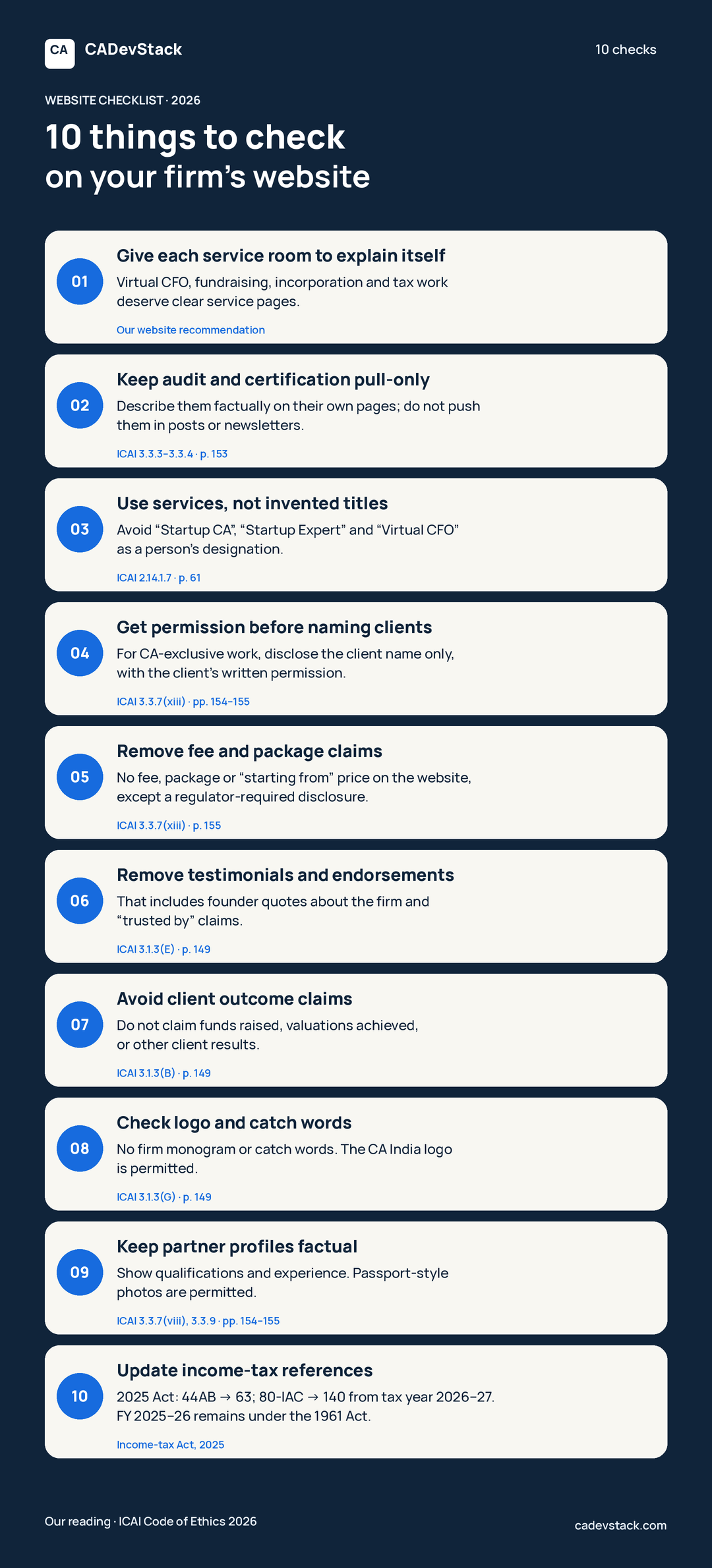
Checklist: 10 things to check on your firm’s website
- Virtual CFO, fundraising, incorporation, and tax services each have a clear page, not just a line in a list.
- Audit and certification services are on their own page, described factually, and absent from posts and newsletters (cl. 3.3.3–3.3.4, p. 153).
- Nobody is called a “Startup CA”, “Startup Expert”, or “Virtual CFO” as a title (cl. 2.14.1.7, p. 61). Describe services, not designations.
- Client names appear only with written permission, and audit clients by name only (cl. 3.3.7(xiii), pp. 154–155).
- No fees, packages, or “starting from” prices (cl. 3.3.7(xiii), p. 155).
- No testimonials, founder quotes about the firm, or “trusted by” lines (cl. 3.1.3E, p. 149).
- No claims about funds raised, valuations achieved, or other results for clients (cl. 3.1.3B, p. 149).
- No firm logo or monogram, and no catch words (cl. 3.1.3G, p. 149; cl. 2.14.1.7). The CA India logo is allowed.
- Partner profiles show qualifications and experience, with passport-style photos (cl. 3.3.9, p. 155).
- Income-tax references are ready for the new Act. The Income-tax Act, 2025 applies from tax year 2026-27: section 44AB becomes section 63, and section 80-IAC becomes section 140. FY 2025-26 still runs under the 1961 Act.
The same checklist as one image, to save or share with your partners (open the full-size image):
Frequently asked questions
Can a CA firm promote virtual CFO services on LinkedIn?
Yes. Virtual CFO work (financial planning, budgets, cash flow, and MIS reporting) falls within the Management Consultancy services the Code lists (cl. 2.2.3, p. 15), and other professionals offer it too. It isn’t reserved for CAs, so it can be promoted in posts and newsletters. Keep the posts factual, with no exaggerated claims (cl. 3.1.3B, p. 149).
Can we call ourselves “Startup CAs” or “startup specialists”?
No. A CA in practice may not use any designation other than “Chartered Accountant” (cl. 2.14.1.7, p. 61). You can say what you do instead: “virtual CFO services for startups”, or a page listing startups among the industries you serve.
Can we name the startups we work with on our website?
Yes, with each client’s permission. For services that aren’t reserved for CAs, such as virtual CFO work, you can also describe the nature of the assignment. For audit clients, only the client’s name may appear. Fees can’t be shown either way (cl. 3.3.7(xiii), pp. 154–155).
Can we write about the startup tax holiday?
Yes. Articles and professional updates are allowed on the website (cl. 3.3.10, p. 155). Under the Income-tax Act, 2025, the holiday is in section 140. It requires the accounts to be “audited by an accountant”, meaning a practising CA (s. 140(8), s. 515(3)(b)). So the article can be shared, but the audit report itself is a pull-only service on your site.
Can we share success stories, like funds a client raised?
No. The Code bans exaggerated claims and testimonials (cl. 3.1.3B and E, p. 149), and a client’s fundraising result isn’t the firm’s to claim. Describe the work you did, not the outcome.
Is a startup’s statutory audit a pull-only service?
Yes. Only a Chartered Accountant can be a company’s auditor (Companies Act, 2013, s. 141(1)), so the statutory audit is reserved for CAs by statute. Your website can describe it factually, but it can’t be promoted through posts, newsletters, or emails (cl. 3.3.3–3.3.4, p. 153).
Sources
- ICAI, Code of Ethics, 2026 (13th edition), Volume I, in force from 1 April 2026. Page numbers above are the printed page numbers.
- Income-tax Act, 2025, as amended by the Finance Act, 2026 (Income Tax Department): sections 63, 140, and 515.
- Companies Act, 2013 (India Code): sections 138 and 141.
- Companies (Incorporation) Rules, 2014 (Ministry of Corporate Affairs); CGST Rules, 2017, rule 83 (CBIC).
This page explains the rules for website purposes and is not legal advice. CADevStack is not affiliated with or endorsed by ICAI.
Get a free review of your firm's website
We check your site against what your clients look for and what the Code allows, and send you a clear list of what to fix first.
Normally ₹7,500. Free while we take on our first 10 client firms. No obligation. We reply within 24 hours on weekdays.