Can a CA Firm Name Its Clients on Its Website? ICAI's 2026 Rules
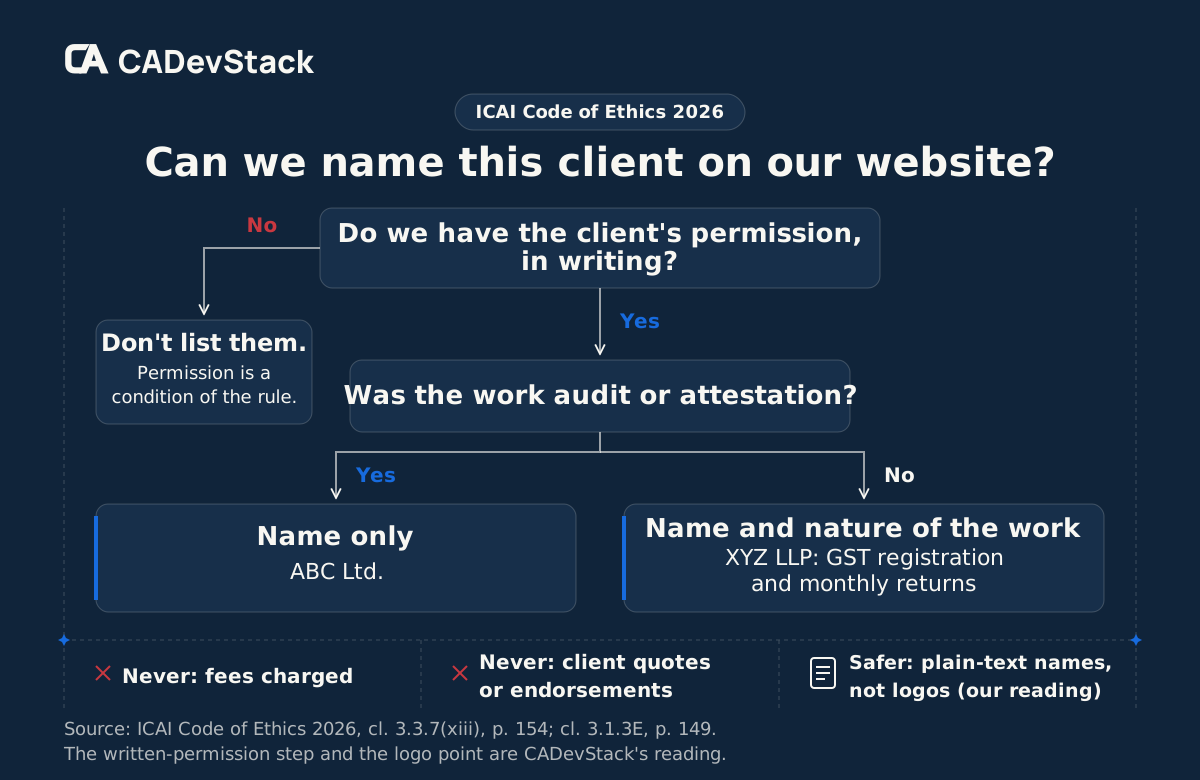
The short answer: Yes. Under ICAI’s Code of Ethics 2026, a CA firm’s website and write-ups may give a client’s name and the nature of the assignment, with the client’s permission. For services reserved for CAs by law, mainly audit and attestation, only the client’s name may be given. Fees charged can’t be shown (cl. 3.2.1(B)(xvi), p. 152; cl. 3.3.7(xiii), p. 154).
Key facts:
- The rule: clauses 3.2.1(A)(xix) and 3.2.1(B)(xvi) for write-ups, and 3.3.7(xiii) for websites, Code of Ethics 2026, Volume I, pp. 151–154.
- In force from: 1 April 2026 (Code of Ethics 2026, p. 222).
- Always needed: the client’s permission. The Code doesn’t say what form it takes.
- Still banned: fees charged, testimonials and endorsements (cl. 3.3.7(xiii), p. 154; cl. 3.1.3E, p. 149).
What does the Code actually say?
The same wording appears three times: for a member’s write-up, for a firm’s write-up, and for the website. The firm version reads:
“Name of the client, and nature of assignment handled, subject to permission of the client. However, for the purpose of services which are exclusively reserved for Chartered Accountants, only client name may be mentioned, subject to permission of the client.” — Code of Ethics 2026, cl. 3.2.1(B)(xvi), p. 152
The member version is identical (cl. 3.2.1(A)(xix), p. 151). The website version adds one sentence at the end:
“Fee charged cannot be given.” — Code of Ethics 2026, cl. 3.3.7(xiii), p. 154
A “write-up” covers print and electronic media, including websites and “social Networking Websites (in Push as well as in Pull mode)” (cl. 3.1.2(iii), pp. 148–149). So the same rule applies on your website, in a directory listing you write, and on your LinkedIn page.
Two levels: name and assignment, or name only
What you may say depends on the kind of service.
| The service you did for the client | What you may show (with permission) | Clause |
|---|---|---|
| Non-exclusive: accounting, tax advisory, GST, company formation, consultancy | The client’s name and the nature of the assignment | cl. 3.3.7(xiii), p. 154 |
| Exclusively reserved for CAs: statutory audit, tax audit, attestation | The client’s name only | cl. 3.3.7(xiii), p. 154 |
The Code describes exclusively reserved services as “services which are exclusively reserved for Chartered Accountants by statute viz. Audit and Attestation Services such as Audit under Companies Act 2013, Income Tax Act 1961, etc.” (cl. 2.14.1.6(iv)C(3), p. 55). Our guide to push vs pull for CA firms has a table of which common services fall on each side.
Our reading: for an audit client, a plain name in a list is fine. “ABC Ltd., statutory audit since 2019” gives the nature of the assignment, which the Code allows only for non-exclusive work. If a client uses you for both, you can name them once and describe only the non-exclusive work.
Whose permission, and in what form?
The Code says “subject to permission of the client” and nothing more. It doesn’t ask for written consent or a set format.
Our reading: get it in writing anyway: an email from the client, or a line in the engagement letter. If ICAI or the client ever asks, you can show it straight away. Ask again before you add a new detail, such as the nature of the assignment.
On who can give consent, the Code’s guidance on disclosing client information (Second Schedule, Clause (1)) is a useful guide. It says consent should come from “a person who is competent to accord such consent”: the proprietor of a proprietary concern, any partner of a partnership firm, and for a company, the Board of Directors or a Managing Director with delegated powers (cl. 2.15.1.1(iv), pp. 108–109).
Our reading: that guidance is written for disclosing client information, not for website lists. It’s the closest the Code comes, so we’d follow it: for a company client, ask a director rather than the accounts team.
Examples: allowed or not?
| What the firm shows | Allowed? | Why |
|---|---|---|
| “Clients include ABC Pvt. Ltd. and XYZ LLP”, plain text, with each client’s permission | Yes | cl. 3.3.7(xiii), p. 154 |
| “XYZ LLP: GST registration and monthly returns”, with permission | Yes | Non-exclusive work: name and nature of assignment (cl. 3.3.7(xiii)) |
| “ABC Ltd.: statutory audit, FY 2024-25”, with permission | No | For exclusive services, only the name may be given (cl. 3.3.7(xiii)) |
| A client list with no permission recorded | No | Permission is a condition of the clause (cl. 3.3.7(xiii)). Disclosing client information without consent can also be misconduct (CA Act 1949, Second Schedule, Part I, cl. (1); Code p. 107) |
| “Annual retainer: ₹1.2 lakh” next to a client’s name | No | “Fee charged cannot be given” (cl. 3.3.7(xiii), p. 154), unless a regulator requires the disclosure (pp. 154–155) |
| A quote from the client: “They saved us lakhs in tax” | No | No “testimonials or endorsements concerning Member(s)” (cl. 3.1.3E, p. 149) |
| A row of client company logos | Risky | Our reading: the Code allows the client’s name and doesn’t mention logos. Plain text is the safer choice |
| “Trusted by 200+ clients” | Risky | Our reading: a count isn’t a client name, and an unverifiable number can read as an exaggerated claim (cl. 3.1.3A–B, p. 149) |
| A case study describing a client’s tax position or numbers | No, unless the client agrees to exactly that | Our reading: the clause covers name and “nature of assignment”, not the client’s affairs. Client information stays confidential (Second Schedule, Part I, cl. (1); cl. 3.3.15, p. 156) |
Client names on LinkedIn and in directories
LinkedIn and other social pages. These are write-ups too (cl. 3.1.2(iii), pp. 148–149), so the same permission rule applies. One extra limit: information about exclusive services can’t be circulated “through E-mail or by any other mode or technique except on a specific “pull” request” (cl. 3.3.4, p. 153).
Our reading: a post that names an audit client and celebrates the engagement is pushing audit information into people’s feeds. Keep audit clients to your website’s client list, and name only non-exclusive clients in posts, with permission.
Specialised directories. In a “Who’s Who” or similar publication, a member “should not, however, give the names of any of his clients” (cl. 3.6, pp. 157–158). Don’t add client names to such listings, even with permission.
Why many websites still get this wrong
Many older ICAI explainers online say client names can’t appear on a CA firm’s website at all. The 2026 Code allows them, with permission, in all three places listed above. Check any advice you read against the clause and its date.
Checklist
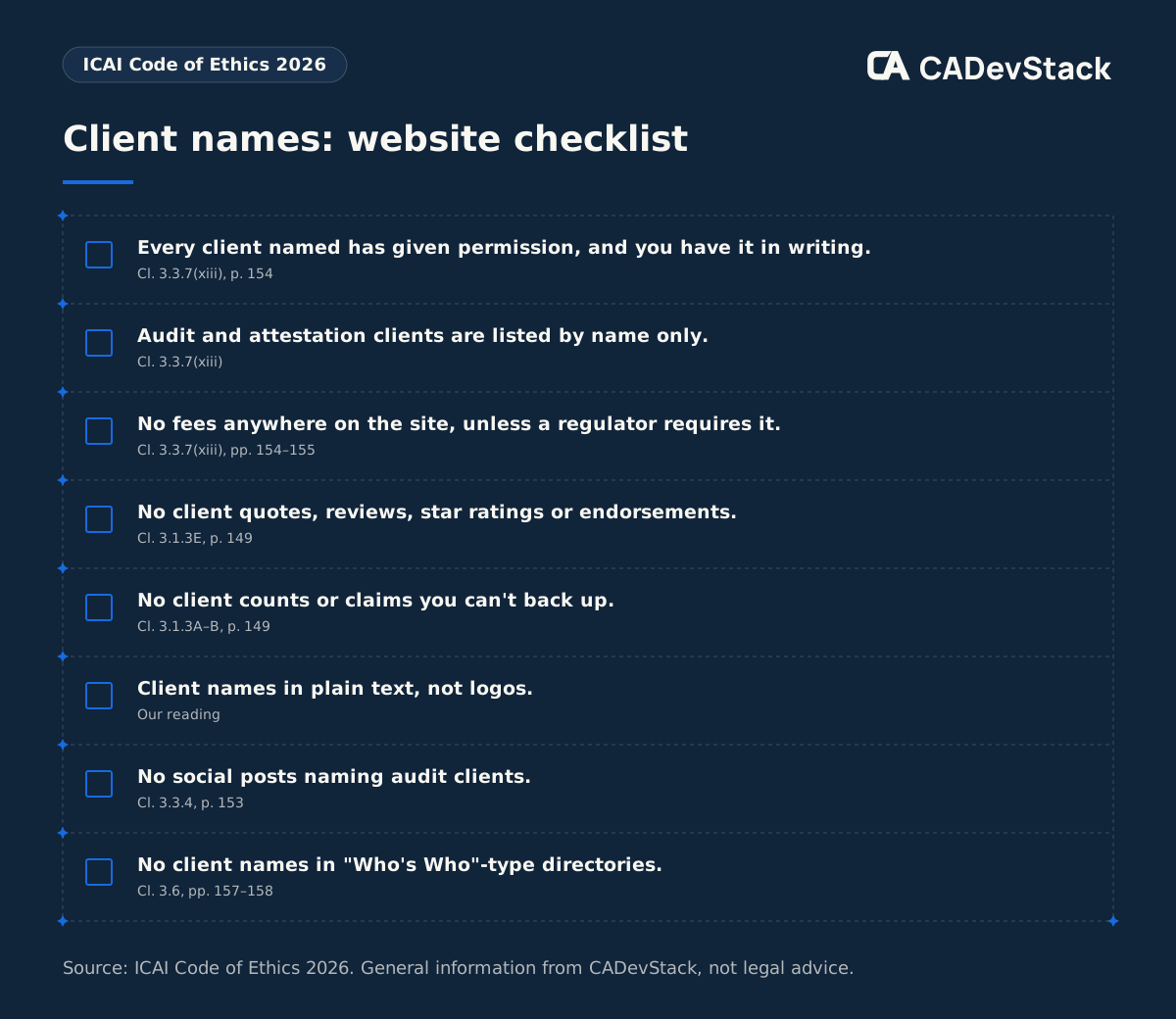
- Every client named on your website or page has given permission, and you have it in writing (cl. 3.3.7(xiii), p. 154).
- Audit and attestation clients are listed by name only, with no assignment details (cl. 3.3.7(xiii)).
- No fees appear anywhere on the site, unless a regulator requires it (cl. 3.3.7(xiii), pp. 154–155).
- No client quotes, reviews, star ratings or endorsements (cl. 3.1.3E, p. 149).
- No client counts or claims you can’t back up (cl. 3.1.3A–B, p. 149).
- Client names are plain text rather than logos (our reading).
- No social posts naming audit clients (cl. 3.3.4, p. 153).
- No client names in “Who’s Who”-type directory listings (cl. 3.6, pp. 157–158).
Want to know whether your client list passes? We’ll check your website against these rules for free and tell you what to change first.
Frequently asked questions
Can a CA firm show client names on its website?
Yes, with the client’s permission (cl. 3.3.7(xiii), p. 154). For non-exclusive work you can also give the nature of the assignment. For audit and other exclusively reserved services, only the client’s name may be shown.
Does the client’s permission have to be in writing?
The Code doesn’t say (cl. 3.3.7(xiii), p. 154). Our reading: get it in writing, by email or in the engagement letter, so you can show it if asked.
Can a CA firm show client logos?
The Code allows the client’s name and doesn’t mention logos (cl. 3.3.7(xiii), p. 154). Our reading: plain text is the safer choice.
Can a CA firm post client testimonials or Google reviews on its website?
No. A write-up “should not contain testimonials or endorsements concerning Member(s) or the fees charged” (cl. 3.1.3E, p. 149).
Can a CA firm show the fees it charged a client?
No. “Fee charged cannot be given” (cl. 3.3.7(xiii), p. 154). The only exception is where a regulator requires the disclosure, and then only to that extent, with a set note in italics below it (pp. 154–155).
Sources
- ICAI Code of Ethics, 2026 (13th Edition), Volume I. Clauses 3.1.2(iii), 3.1.3A, B and E, 3.2.1(A)(xix), 3.2.1(B)(xvi), 3.3.4, 3.3.7(xiii), 3.3.15, 3.6; 2.14.1.6(iv)C(3); 2.15.1.1(iv); effective date, p. 222. Code of Ethics 2026, Volume I (PDF, icai.org)
- The Chartered Accountants Act, 1949, Second Schedule, Part I, Clause (1). India Code (indiacode.nic.in)
- Our full guide: ICAI advertising and website rules for CA firms (2026), with every rule cited to its clause and page.
Disclaimer
This guide is written by CADevStack, not by a practising Chartered Accountant. Every rule is quoted from and cited to the ICAI Code of Ethics 2026; where the Code is silent, we say so and label our reading. It’s general information, not legal advice. For your firm’s situation, read the Code and ask ICAI’s Ethical Standards Board through its queries page.
Changelog
- 13 October 2026: Published on CADevStack.com.